
The adoption of ESCO by the Greek Public Employment Service (OAED)
This testimonial is part of a series of interviews conducted by the Commission with ESCO implementers.
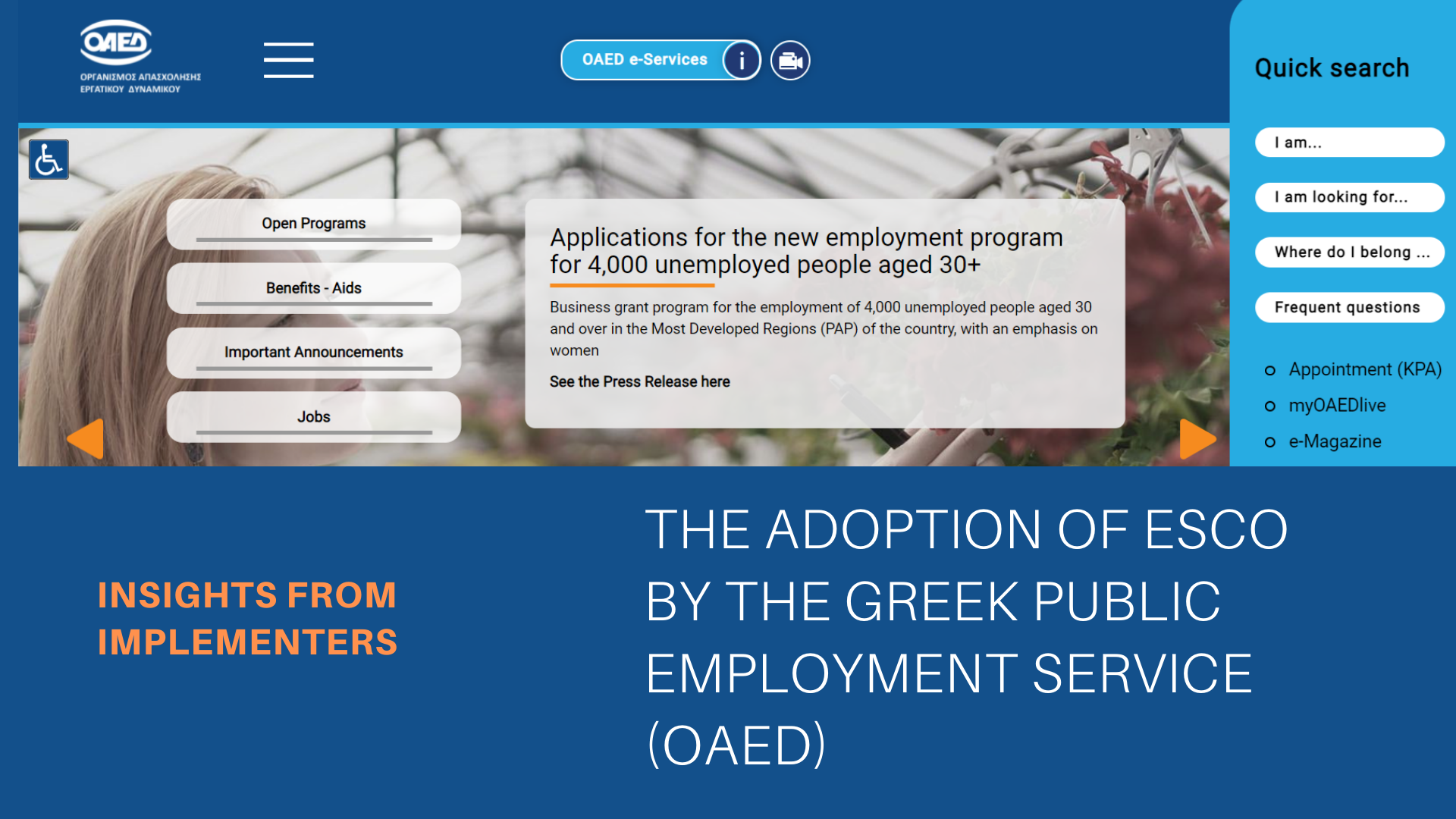
The following testimonial is part of a series of interviews conducted by the Commission with ESCO implementers. Their purpose is to shed a light on ESCO strengths and challenges as perceived by implementers, so that current and potential future stakeholders can gain a better knowledge on the use of ESCO.
Tell us a bit more about your organisation.
OAED (Manpower Employment Organization)is the Greek Public Employment Service, responsible for the administration of active and passive labour market policies at the national level. It has further responsibilities for the management of VET schools/institutes, day nurseries, social housing, and social tourism programmes. Its main customers are registered jobseekers (currently, approx. 790,000)and, potentially, all companies with salaried employees (currently, approx. 250,000).
How do you leverage ESCO in your services and since when are you using it?
OAED adopted ESCO on December 13, 2021, and has since been using it for all its services (registration, employment counselling, matching, etc.).
What were some of the challenges you encountered in implementing ESCO?
A key challenge (in both conceptual and technical terms) was related to employing ESCO for the pre-existing entries in OAED’s Information System, which had been based on the Hellenic Statistical Authority’s Statistical Classification of Occupations/STEP-92. Another challenge concerned the timely training of all internal users (e.g. OAED employment counsellors),so that the new system could be effectively used from the very first day of its implementation. A further challenge is related to OAED’s ongoing effort to raise awareness of ESCO’s advantages amongst all stakeholders, so that it can be adopted as the national classification of skills/competences and occupations.
What is the key ingredient in ESCO that made you take the decision to use it in your system?
Since its previous classification system(STEP-92) was no longer fully relevant to current labour market features, nor did it comprise a classification of skills, OAED made preparations for a transition to ISCO and, subsequently, to ESCO. This decision was supported by the fact that (i) skills classification is crucial to all labour market integration initiatives; (ii) ESCO is a dynamic tool adaptable to changing labour market features and needs (new skills and occupations, etc.).
What was the level of acceptance by your partners/other national stakeholders?
OAED implemented the EaSI-funded “MATCHING” project with the aim of adopting ESCO.As part of this project, OAED organized several activities to promote the use of ESCO at the national level, including: (i) a Workshop bringing together key national stakeholders; (ii) a Conference, in which OAED experts, representatives of academic and research institutions, the European Commission, social partners, and the business world highlighted ESCO’s relevance to Public Employment Services and its contribution to, inter alia, skills development, job matching and labour market data analysis. All national stakeholders recognized that ESCO has several advantages to offer to all organizations interested/engaging in classifying skills and occupations.
What are some of your recommendations for other stakeholders looking to implement ESCO in their system?
All future ESCO users in Greece should closely collaborate with OAED and each other in order to ensure that (i) the terminology employed is fully harmonized with the one actually used in the labour market; (ii) relevant information on skills and occupations is exchanged, processed, and duly transferred to / taken into account by the European Commission.
How has ESCO helped your organisation? What are its advantages and disadvantages from your standpoint?
ESCO’s launch has been favourably received by users, notably the unemployed. The skills component, in particular, has significantly supported such key PES functions as job matching. The first evaluation results point to the need that users should be constantly supported/informed about ESCO’s functions before they can be fully familiarized with it.
 Twitter
 Facebook
 Linkedin
 Email
Email