
The information below is the result of a year-long work (2021-2022) to evaluate the ongoing ESCO project. Its goal was to assess informally whether ESCO is achieving its policy goals, to identify the factors driving ESCO’s performance and what are the high-order effects of the changes that ESCO is inducing in the labour market and education and training. Ultimately, it aimed to provide an objective judgement on ESCO's role and impact on the European labour market.
Methodology & limitations
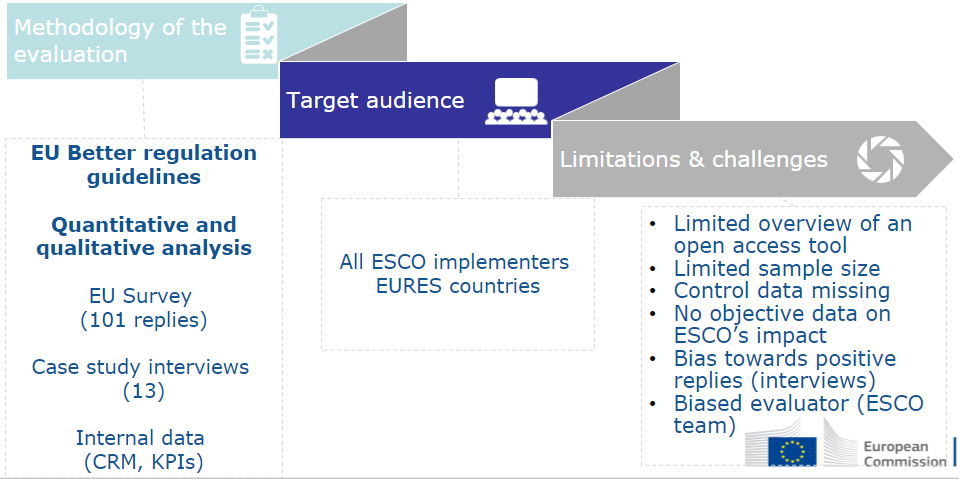
Our team used a mix of evaluation methods (quantitative and qualitative data) such as:
- a survey addressed to ESCO implementers and the EURES Member States;
- interviews;
- statistics from in-house data regarding the identified ESCO implementers;
- research papers using ESCO;
- internal data from EURES vacancies and Europass CVs.
These data were systematically triangulated to answer the evaluation questions.
As ESCO is a tool that is primarily used in applications or projects which in turn benefit end-users like unemployed people, students, employers, policy-makers etc., our choice was to target ESCO implementers, from both EU and non-EU countries, from all sectors: public, private, non-profit and start-ups. One limitation in choosing the sample population was that counterfactual data (information on the labour market and its actors without the existence of ESCO) was very difficult to obtain, so the efforts were focused only on ESCO implementers also given the available timeframe.
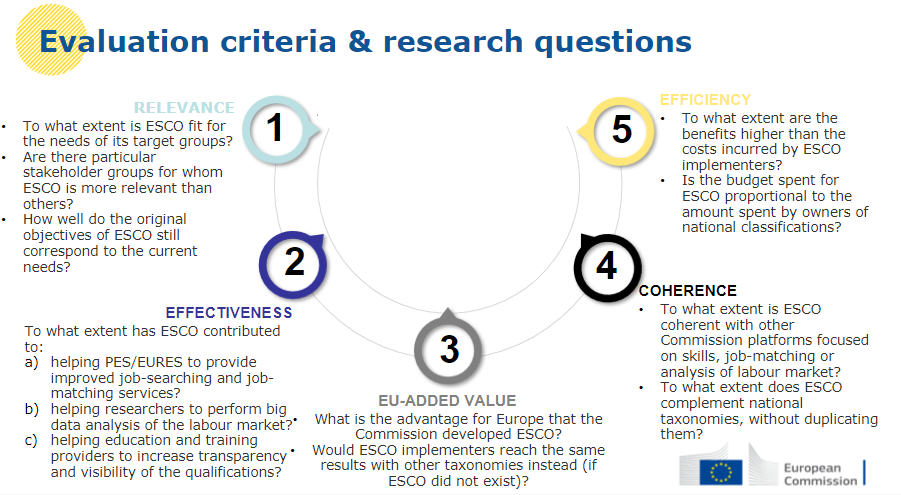
Our team used the EU Better Regulation guidelines as inspiration and used the same evaluation criteria (relevance, effectiveness, coherence, efficiency and EU-added value) to stay as close as possible to the standard for evaluations of EU policy, programmes or projects. Nonetheless, this evaluation is not an official evaluation as defined by the Commission in its law- and policy-making cycle procedures.
The picture below summarises our methodology and limitations we encountered.
Evaluation research questions and criteria
Based on the results framework of ESCO, our team summarised the evaluation questions per each criteria as follows:
Evaluation findings
The main findings of the analysis are the following:
Overview of implementers
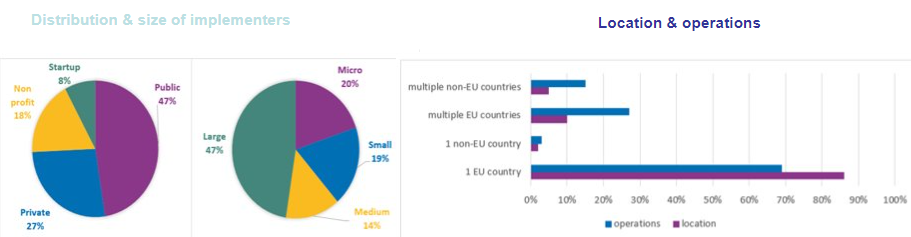
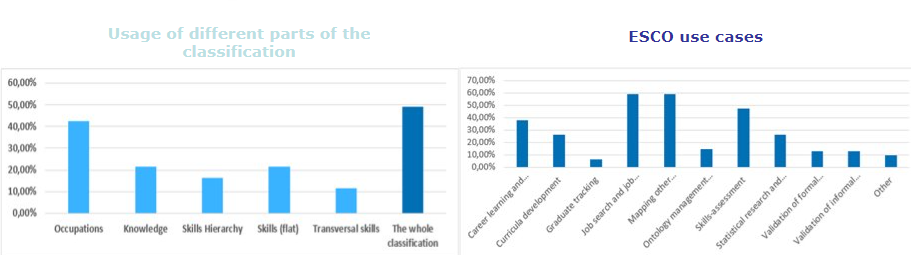
In the following sections, we will present the findings per each evaluation criteria.
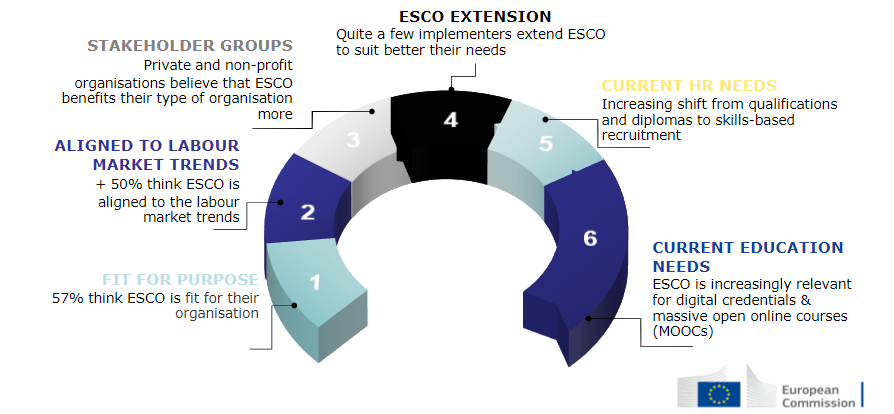
RELEVANCE
EFFECTIVENESS
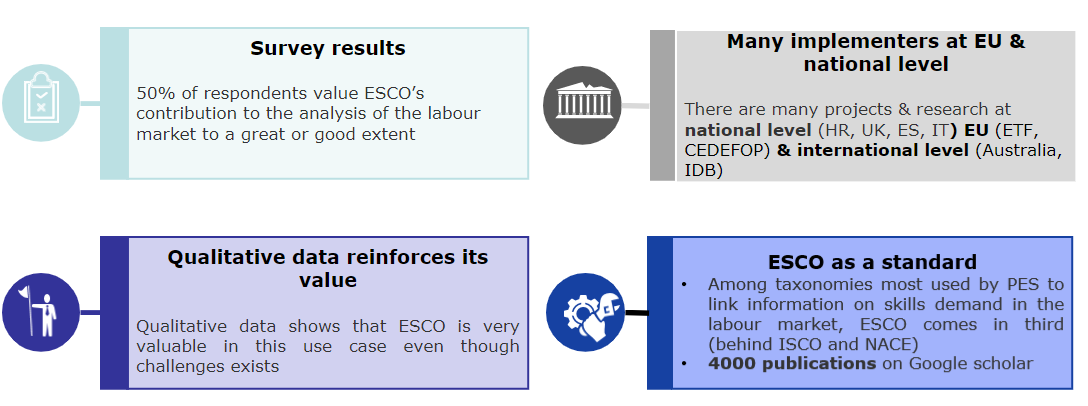
Skills intelligence use case
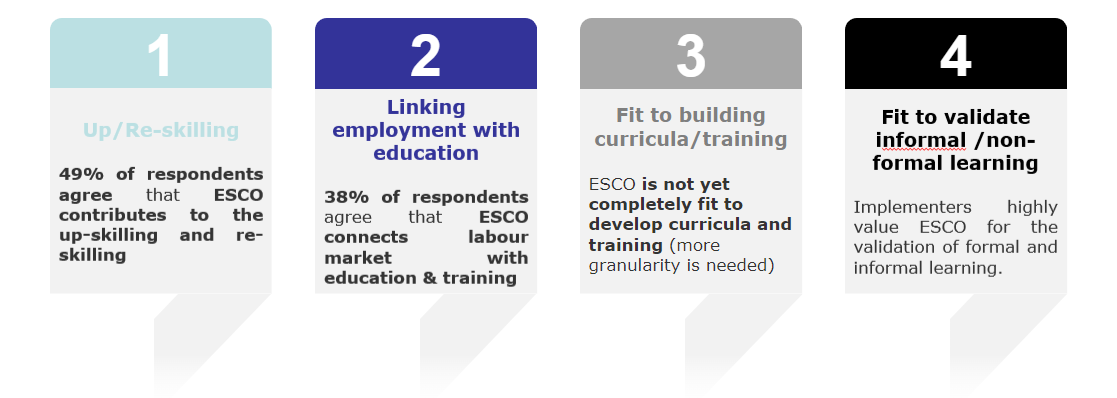
Connecting labour market and education/training use case
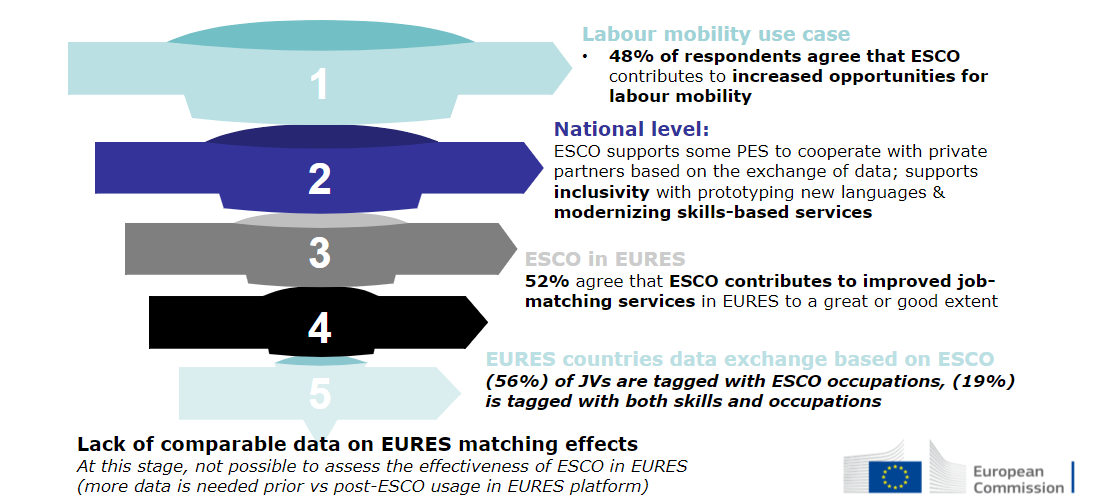
Connecting people to jobs use case
EU-ADDED VALUE
COHERENCE
EFFICIENCY
Challenges with the use of ESCO
Recommendations
 Twitter
 Facebook
 Linkedin
 Email
Email